
Turmeric
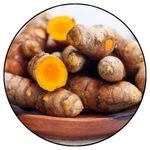
Common Name: Turmeric
Botanical Name
Curcuma longa L.
Family
Zingiberaceae
Commercial Part
Rhizome (Underground stem)
Description
Turmeric is the processed form of the rhizomes (boiled, dried, cleaned, and polished) of Curcuma longa. It is a herbaceous perennial plant, growing to a height of 60–90 cm. The plant has 7 to 12 large, bright green leaves that form a pseudostem through overlapping sheaths. The leaf lamina is green above and pale green below.
The inflorescence is a central spike (10–15 cm long) arising from the pseudostem. Each spike bears around 30 flowers, usually 1–4 per axil of the bracts, opening one at a time. Seeds are borne in sunken capsules, although turmeric is generally propagated vegetatively through rhizomes rather than seeds.
Climatic Requirements for Cultivation
- Climate: Tropical, hot and humid
- Altitude: Sea level to 1200 m above mean sea level
- Rainfall: 1500–2000 mm annually (well-distributed)
- Temperature: 20–30°C (optimal)
- Soil: Well-drained sandy loam, clay loam, or red soils rich in organic matter. Cannot tolerate waterlogging or alkaline soils.
- Irrigation: Can be cultivated under both rainfed and irrigated conditions
Origin and Distribution
Turmeric is believed to have originated in India and Southeast Asia. It is now cultivated in many tropical regions worldwide including:
- India
- China
- Indonesia
- Bangladesh
- Sri Lanka
- Myanmar
- Thailand
- Peru
India is the largest producer, consumer, and exporter of turmeric in the world.
Major Growing Areas in India
- Andhra Pradesh (especially Nizamabad)
- Telangana
- Tamil Nadu
- Odisha
- West Bengal
- Maharashtra
- Karnataka
- Kerala
- Assam
- Meghalaya
Popular Varieties
- Roma (Odisha)
- Suvarna
- Rajendra Sonia (Bihar)
- Suguna, Sudarsana, Prabha, Pratibha (Released by ICAR-IISR, Kerala)
- Krishna – High curcumin content
- Erode local – Popular in Tamil Nadu
- Alleppey Finger – High quality for export
- Salem – Famous variety from Tamil Nadu
Important Uses
Culinary:
- Primary ingredient in curry powders, masalas, and pickles
- Used to flavour and colour food in various cuisines
- Oleoresin is used in processed foods like butter, cheese, mayonnaise, gelatin, sauces, and non-alcoholic beverages
Industrial:
- Natural colorant (Curcumin) used in the food and textile industries
- Dye in textile printing and cosmetics
- Ingredient in biopesticides (aqueous extracts used against pests)
Medicinal:
- Used in Ayurvedic and Unani systems of medicine
- Properties: Antiseptic, anti-inflammatory, blood purifier, stomachic, carminative, tonic
- Used in medicinal oils, ointments, and poultices
Indian Names of Turmeric
- Hindi: Haldi
- Bengali: Halud, Pitras
- Gujarati: Haldhar, Haldi
- Kannada: Arishia
- Konkani: Halad
- Malayalam: Manjal
- Marathi: Halede, Halad
- Oriya: Haldil
- Punjabi: Haldar, Haldhar, Haldi
- Sanskrit: Haladi, Harita
- Tamil: Manjal
- Telugu: Pasupu
- Urdu: Haladi
Foreign Names of Turmeric
- Spanish: Cúrcuma
- French: Curcuma
- German: Kurkuma, Gelbwurzel
- Swedish: Gurkmeja
- Arabic: Kurkum
- Dutch: Geelwortel
- Italian: Curcuma
- Portuguese: Açafrão-da-Índia
- Russian: Zholty Imbir
- Japanese: Ukon
- Chinese: Yu Jin (郁金)