
Nutmeg
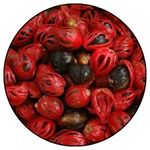
Common Name: Nutmeg
Botanical Name
Myristica fragrans
Family
Myristicaceae
Commercial Part
- Nutmeg: Dried seed kernel
- Mace: Dried reticulated aril (lacy covering of the seed)
Description
Nutmeg and Mace are two different spices derived from the same fruit of an evergreen tree (Myristica fragrans), which grows up to 9–12 meters tall.
- Nutmeg is the dried kernel of the seed.
- Mace is the dried lacy covering (aril) surrounding the seed.
The tree is typically dioecious, bearing either male or female flowers.
- Male flowers occur in clusters
- Female flowers are usually solitary
The fruit is a fleshy drupe, spherical and pale yellow, with a characteristic longitudinal groove. Upon ripening, the fruit splits open, revealing the bright red or orange mace, which envelops the hard, black shiny seed (nutmeg).
Climatic Requirements for Cultivation
- Climate: Warm and humid tropical
- Altitude: Sea level to 600 meters MSL
- Rainfall: Well-distributed annual rainfall of around 250 cm
- Temperature: 20–30°C
- Soil: Grows on sandy loam to clayey loam and lateritic soils with good drainage
- Shade: Requires partial shade during initial growth; often intercropped in coconut or arecanut plantations
Origin and Distribution
- Origin: Moluccas (Spice Islands of Indonesia)
- Major Growing Countries:
- Indonesia (largest producer)
- Grenada (known as the "Isle of Spice")
- India
- Sri Lanka
- Malaysia
- China
- Zanzibar
- Mauritius
- Solomon Islands
In India, nutmeg is mainly cultivated in Kerala, Karnataka, and Tamil Nadu.
Major Growing Areas in India
- Kerala – Idukki, Thrissur, Ernakulam
- Tamil Nadu – Coimbatore, Nilgiris
- Karnataka – Kodagu, Chikkamagaluru
Popular Varieties
Nutmeg is generally not classified into specific named varieties commercially. However, selections are based on:
- High yield
- Oil content
- Bright red mace
- Bold seeds
Research stations such as ICAR-IISR have worked on clonal selections like IISR Viswasree.
Important Uses
Culinary:
- Nutmeg and mace are used as condiments and flavouring agents
- Nutmeg: Used in sweet dishes, desserts, custards, puddings, bakery products, sauces, soups
- Mace: Used in savoury dishes, pickles, sauces, and spice blends
- Mace is valued for its aroma, while nutmeg provides warm, spicy-sweet flavour
Food Industry:
- Nutmeg oleoresin and oil are used in processed foods, meat products, confectionery, and baked goods
Medicinal:
- Used in traditional medicine systems like Ayurveda and Unani
- Nutmeg has stimulant, carminative, aphrodisiac, and astringent properties
- Excessive consumption may have narcotic effects
- Mace is used in digestive tonics and aphrodisiac formulations
Industrial:
- Nutmeg oil is used in perfumery, cosmetics, and toiletries
Indian Names of Nutmeg
- Hindi: Jaiphal
- Bengali: Jaiphal
- Gujarati: Jaiphal
- Kannada: Jayikai
- Kashmiri: Zaaphal
- Malayalam: Jathikka
- Marathi: Jaiphal
- Oriya: Jaiphala
- Punjabi: Jaiphal
- Sanskrit: Jatiphala
- Tamil: Jathikai
- Telugu: Jajikai
- Urdu: Jaiphal
Foreign Names of Nutmeg
- Arabic: Jouza at-Teeb
- Chinese: Dou kou shu
- Dutch: Nootmuskaat
- French: Muscade
- German: Muskatnuss
- Greek: Moschokarido
- Indonesian: Pala
- Italian: Noce moscata
- Spanish: Moscada